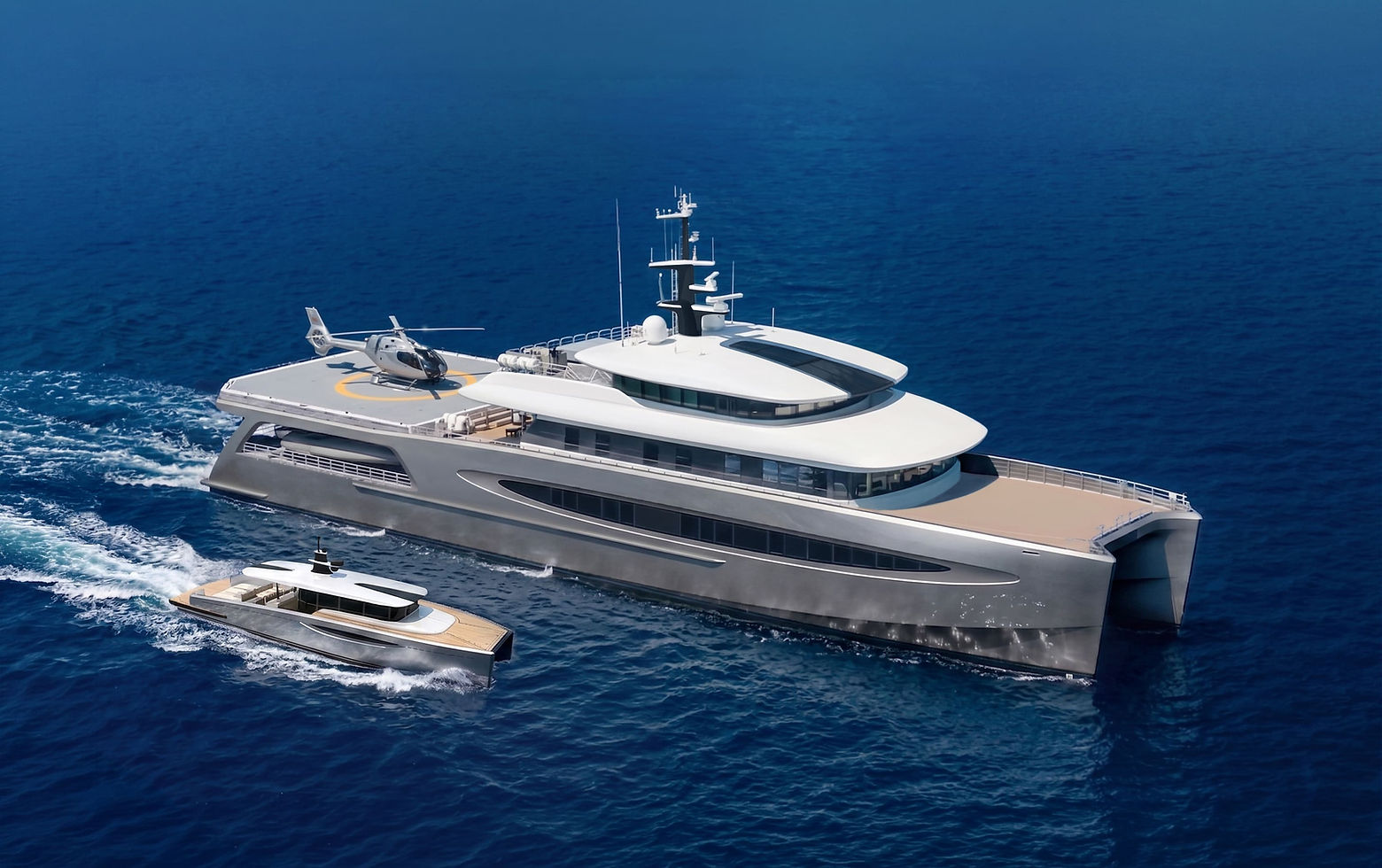
A Fleetwise Approach to Superyacht Tenders

Updated: Sep 26
Defining the fleet, interfaces and programme before developing the individual vessels
A large yacht may carry several tenders and specialist craft, each with different guest, operational and regulatory roles.
If those vessels are developed individually, decisions can quickly become fragmented. Capabilities may overlap, important interfaces can be identified late and information required by the mothership may arrive after key design decisions have been made.
The better starting point is to look at the fleet as a whole.

Start with what the fleet needs to do
It is easy for a tender project to begin with the individual boats.
Which builder? Which model? What size? Production or custom?
But there is a more fundamental question to answer first:
What does the fleet actually need to do?
Guest transfer, beach access, watersports, exploration, luggage, provisioning, rescue duties and stand-alone operation can create very different requirements.
Looking across these requirements together helps establish the capabilities the yacht actually needs, how they should be distributed between vessels and where there may be gaps or unnecessary duplication.
Only then can the role and requirements of each individual vessel be properly defined.

Connect the fleet to the mothership
The other half of the equation is the yacht itself.
Garage envelopes, cranes and lifting arrangements, boarding positions, services, access, maintenance and other interfaces can materially influence the tender solution.
These requirements often develop in parallel with the mothership.
Understanding them early allows the yacht and its tender fleet to develop together, rather than discovering conflicts after vessels have been selected or key design decisions have already been made.

Choose the right solution route
Fleet definition does not mean designing a custom tender for every requirement.
Once the role of each vessel is understood, there are broadly three development routes:
Existing: a proven vessel already meets the requirement with limited modification.
Adapted: an established platform provides the right basis but requires changes to suit the project.
Purpose-developed: the operational requirement or mothership interface justifies a dedicated solution.
There is no inherently better route. The objective is to define the requirement first, then select the most appropriate solution.
This allows development time, cost and technical resources to be focused where they add value.

Build the programme backwards from delivery
A yacht delivering several years from now can make tender decisions appear distant.
In practice, different vessels can require very different development and construction periods. The mothership team may also need information from the tender projects long before the boats themselves are built.
Dimensions, weights, lifting arrangements, chocks, services and other interfaces can influence the yacht’s own design, engineering and construction programme.
A tender fleet master programme establishes what needs to be decided, developed and communicated, and when.
Seeing the whole picture
Tender responsibilities frequently sit across the owner, project manager, captain, mothership yard, designers, engineers and individual tender builders.
Each may be responsible for part of the project but the challenge is maintaining oversight across the whole tender system.
Dedicated specialist resources can provide continuity between the owner’s requirements, the mothership interfaces, individual vessel projects and the overall programme, while supporting the existing client and project teams.
This becomes particularly important where several vessels, suppliers and development routes are progressing simultaneously.

From fleet definition to delivery
For a complex tender programme, the process can be considered in three connected stages:
DEFINE THE FLEET → DEVELOP THE VESSELS → DELIVER THE SYSTEM
Fleet definition establishes the operational requirements, mothership interfaces, solution strategy, preliminary vessel requirements and master programme.
Individual vessel development can then follow the appropriate route, from evaluating an existing product through adaptation or purpose-development, followed by technical definition, specification, builder engagement and procurement.
The process continues through detailed integration, construction, testing, acceptance, commissioning and delivery.
The detail will be different for every project but the principle remains consistent:
Define the requirement before committing to the solution.
Thinking fleetwise
A tender fleet is more than a collection of individual boats. It is part of the yacht’s wider operational system.
Looking at the fleet as a whole, early enough in the project, provides a clearer basis for the decisions that follow and helps align the owner, project team, mothership and individual vessel programmes.
This is what we mean by taking a fleetwise approach to superyacht tenders.
SPARK Marine Projects supports client and project teams through the definition, development, integration, procurement and delivery of tenders, chaseboats and specialist vessels.
Defined. Aligned. Delivered


Comments